Most efficient 12V fridges: stated power draw compared, and what it means for your battery
The most efficient 12V fridges by stated power draw: ECO and MAX watts compared, watts per day, and how long a 12V fridge runs on a battery.


Most 12V compressor fridges list two power figures, an ECO number and a MAX number, and neither one tells you how much of your battery is gone by morning. That depends on how often the compressor runs. Here are the lowest draws stated on the fridges we rate, the arithmetic that turns watts into hours on a battery, and the habits that cut the total wherever you park.
Affiliate disclosureAs an Amazon Associate we earn from qualifying purchases made through links on this page. Commissions never change our ratings.
Which 12V fridges state the lowest power draw
Short answer Among the fridges we rate, the lowest ECO figures stated in the listings are 25 W (Tecnolove 21 Qt Compressor Cooler), 28 W (Setpower RF20 and RF25), under 30 W (the Feelfunn 40, 50 and 61 Qt dual-zone fridges and the BougeRV 50 Qt Car Fridge) and 33 W (EUHOMY 48 Qt Dual-Zone). The most common pair in our catalog is 45 W in ECO and 60 W in MAX. Those numbers describe the compressor while it runs. They are not a daily total.
If I had to shortlist on the power claims alone, I would start with the Feelfunn family. The same "under 30 W" ECO figure is stated for the 40, 50 and 61 quart boxes, and the Feelfunn 61 Qt Dual-Zone is rated 8.5/10 on a solid buyer record. A big fridge that claims small-fridge draw is exactly what you want when it has to live off a battery for a long weekend.
The lowest claim isn't automatically the best buy, though. The Tecnolove states the smallest ECO figure of the lot and still rates 4.0/10, on a thin buyer record. Read a watt number as one line of the decision, next to the size you actually need and the rating behind it.
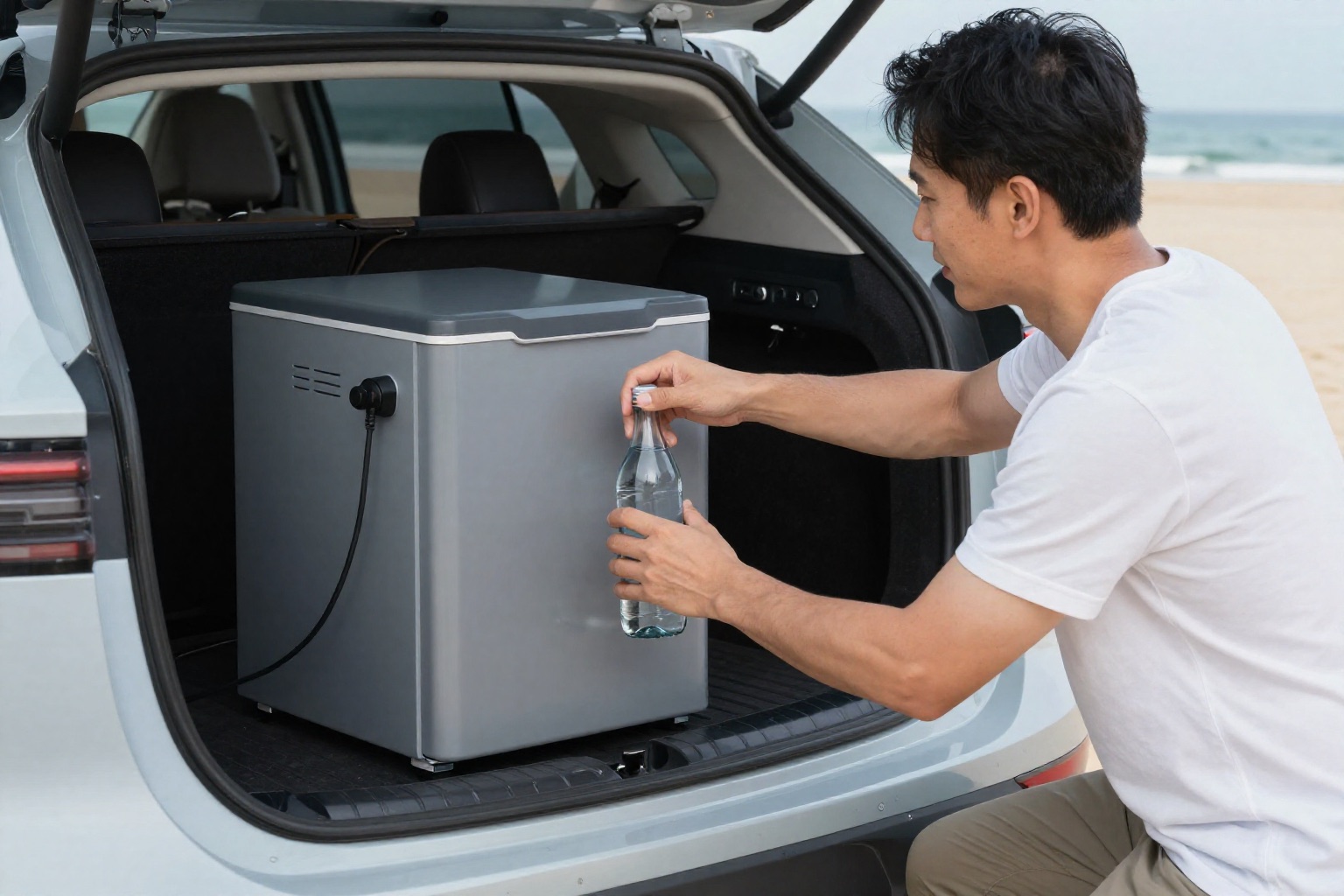
Why the watts on the box are not what your battery feels
A compressor fridge doesn't pull its rated watts around the clock. It runs until the inside reaches the temperature you set, switches off, and starts again when the temperature creeps back up. ECO and MAX describe the compressor while it is running. Your battery feels the average over the day, and that average depends on how much of each hour the compressor is on.
You can see the gap in the sellers' own numbers. BougeRV states "up to 18 hours of runtime under certain conditions" for the BougeRV CRD2 V2 52QT + 240Wh Battery, which comes with a 240 Wh battery. Spread 240 Wh over 18 hours and you get an average of about 13 W, roughly a third of a 45 W ECO figure. The BougeRV CRH20 21QT claims up to 30 hours on the same 240 Wh pack, which works out to 8 W. LiTHELi states up to 12 hours of cooling from the two 74 Wh batteries of the LiTHELi 21 Qt with 2 U20 Batteries, about 12 W on average. These are best-case claims under conditions the listings don't spell out, but they show why a 45 W fridge doesn't drain 45 Wh from your battery every hour.
The share of time the compressor runs, the duty cycle, comes down to a handful of things: the heat around the box, the temperature you set, how full and how cold the load was when it went in, how often the lid opens, the insulation, and whether the vents can breathe. The same fridge will cycle far more in a 95°F car with the lid opening every twenty minutes than at a shaded campsite at night.
Stated power draw, fridge by fridge
Below is every fridge in our catalog whose listing states a figure under the common 45 W ECO and 60 W MAX pair, plus a few best-rated models at that pair for comparison. The wording is copied from the exact listing ("under", "about", "average"), with our rating next to it. Click a name for the full specs and the current price.
| Fridge | Capacity | Lowest mode | MAX mode | Rating |
|---|---|---|---|---|
| Tecnolove 21 Qt Compressor Cooler | 21 qt | ECO 25 W | 45 W | 4.0/10 |
| Setpower RF20 21 Qt | 21 qt | ECO 28 W | 40 W | 7.1/10 |
| Setpower RF25 27 Qt | 27 qt | ECO 28 W | 40 W | 6.1/10 |
| Feelfunn 61 Qt Dual-Zone | 61 qt | ECO under 30 W | 50 W | 8.5/10 |
| BougeRV 50 Qt Car Fridge | 50 qt | ECO below 30 W | Not stated | 7.2/10 |
| EUHOMY 48 Qt Dual-Zone | 48 qt | 33 W, single figure | 33 W | 7.7/10 |
| Setpower 48 Qt Dual-Zone | 48 qt | MIN 38 W | 50 W | 9.2/10 |
| VEVOR 15 L Armrest Fridge | 15 L (15.9 qt) | ECO under 38 W | 44 W | 5.9/10 |
| Aeitto 20 Qt Car Fridge | 20 qt | ECO below 40 W | 55 W | 6.7/10 |
| VEVOR 52.8 Qt Dual-Zone | 52.8 qt | ECO under 45 W | 61 W | 8.2/10 |
| BougeRV CR22 23 Qt | 23 qt | ECO about 45 W | 60 W | 9.2/10 |
| EKOJUCE 58 Qt Dual-Zone | 58 qt | ECO under 50 W | Under 60 W | 8.1/10 |
| VEVOR 61.5 Qt Dual-Zone | 61.5 qt | ECO under 54 W | 71 W | 8.3/10 |
| EUHOMY 59 Qt Car Fridge | 59 qt | 45 W average | Not stated | 8.6/10 |
| BODEGACOOLER 100 Qt Dual-Zone | 100 qt | 60 W average | Not stated | 8.7/10 |
Two things stand out. First, bigger is not automatically hungrier. Feelfunn states the same ECO figure at 40 and 61 quarts, and the Setpower 48 Qt Dual-Zone claims a lower minimum (38 W) than plenty of 20-quart boxes at 45 W. Insulation and the compressor matter more than the quart number. Second, "average" and "ECO" are different claims. EUHOMY gives 45 W as an average across most of its range, from the 11 Qt to the 59 Qt, which describes the mix of modes, while BougeRV and Setpower state what each mode draws.
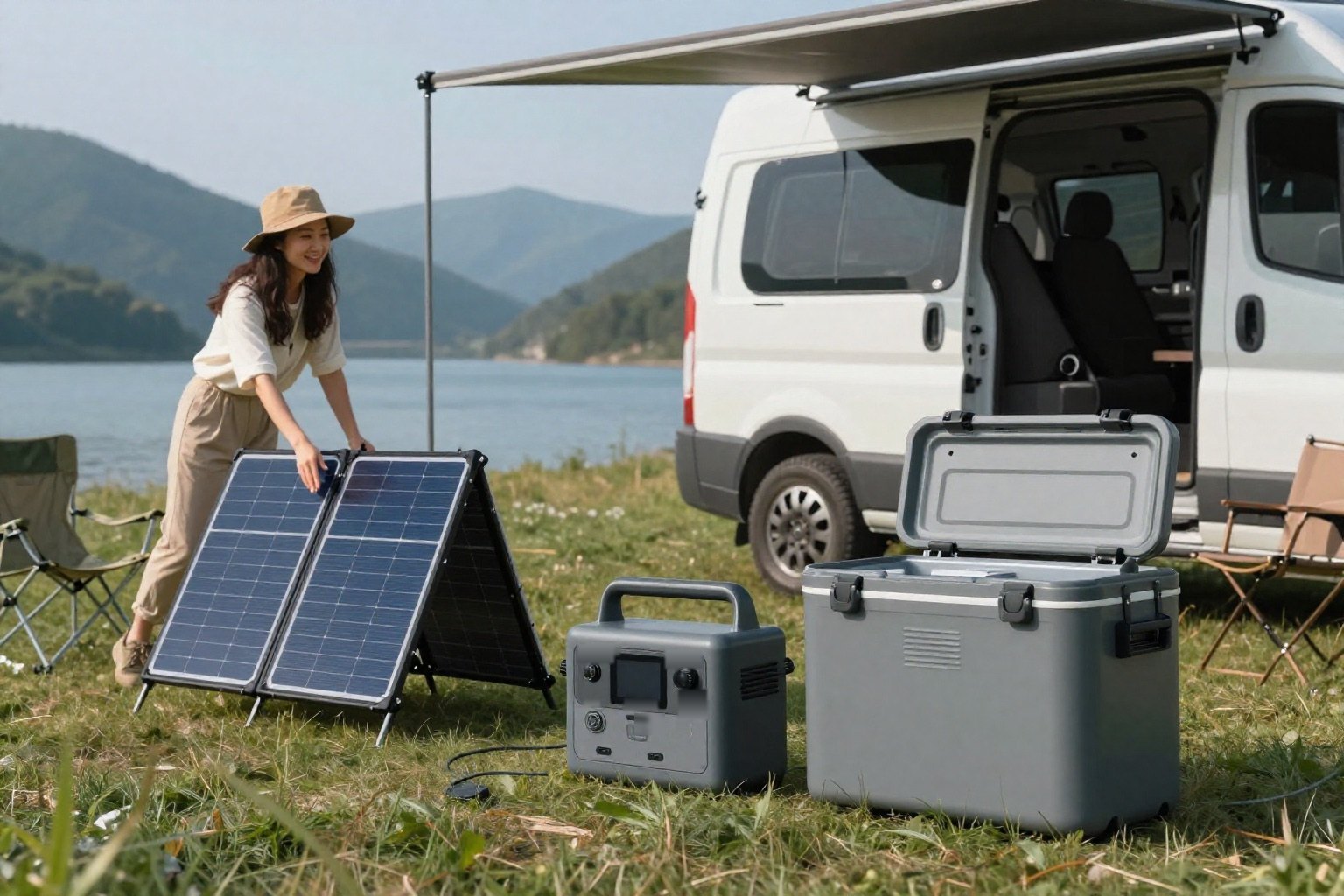
How many watts does a 12V fridge use in a day?
Multiply the average draw by 24 hours and you have watt-hours per day. That's the figure to plan with, because batteries and power stations are rated in watt-hours, or in amp-hours that you turn into watt-hours by multiplying by the battery voltage.
Many listings put a ceiling on it for you. Setpower, BougeRV, Feelfunn, Aeitto, VEVOR and Tecnolove all state that their fridges use less than 1 kWh a day, often crediting smart or intelligent cycling. 1 kWh, or 1,000 Wh, a day is an average of about 42 W, or about 3.5 amps at 12 V. That's the upper bound the sellers commit to, not a typical day. The runtime claims above imply much lower averages in mild weather.
| Average draw | Per day (× 24 h) | At 12 V (÷ 12) |
|---|---|---|
| 10 W | 240 Wh | about 20 Ah |
| 15 W | 360 Wh | about 30 Ah |
| 20 W | 480 Wh | about 40 Ah |
| 30 W | 720 Wh | about 60 Ah |
| About 42 W (the "under 1 kWh a day" ceiling) | 1,000 Wh | about 83 Ah |
My advice: plan with the ceiling, hope for the runtime claim. Budget for the seller's 1 kWh on a hot day and treat a cool night as a bonus. Once your power station or battery monitor has logged a trip or two, switch to your own numbers.
How long will a 12V fridge run on a battery?
The formula is short: usable watt-hours divided by the average draw in watts gives you hours. The two inputs are where people get caught out.
Start with usable watt-hours. A 12 V, 100 Ah battery holds about 1,200 Wh on paper, and you shouldn't plan on all of it. Lead-acid batteries are generally not meant to be drained much below half, while lithium (LiFePO4) packs let you use most of their rating; check what your battery's maker allows. On a power station, running the fridge from the AC outlet through the inverter wastes some energy, so use the 12 V output whenever your fridge came with a DC cord.
| Average draw over the day | 240 Wh pack | 600 Wh usable | 1,000 Wh usable |
|---|---|---|---|
| 10 W | about 24 h | about 60 h | about 100 h |
| 15 W | about 16 h | about 40 h | about 67 h |
| 20 W | about 12 h | about 30 h | about 50 h |
| 30 W | about 8 h | about 20 h | about 33 h |
| 42 W (the "under 1 kWh a day" ceiling) | about 5.7 h | about 14 h | about 24 h |
Then there's the low-voltage cutoff. Many compressor fridges let you choose a battery protection level, and that setting decides how much of the battery the fridge is allowed to use. Dometic, for one, explains that the CFX3 system watches the incoming DC voltage and shuts the fridge down when it drops. Keep the cutoff high on a starter battery and lower only on a separate house battery. Our battery protection guide explains what the setting can and can't do, and the power connection checklist covers the socket, fuse and cable between them.
Want the fridge to carry its own power? Look at our 12V fridges with removable batteries. The runtimes stated on those listings run from about 12 hours (LiTHELi, two 74 Wh packs) to 30 hours (BougeRV CRH20 with a 240 Wh pack), always "under certain conditions".
What actually makes a 12V fridge efficient
Once you own the fridge, the way you use it matters more for the daily total than a few watts on the spec sheet. These habits pay off:
- Shade and air. Setpower's own listing says to keep its fridge out of direct sunlight for long periods, and every compressor needs room to push its heat out. A fridge jammed against bags with its vents covered works harder for the same temperature. Our placement guide shows what to leave free.
- Pre-chill at home. Cool the fridge and the food on mains power the night before. LiTHELi states that pre-cooling on AC or DC stretches one battery to 8 hours on its fridge. Pulling warm drinks down to 37°F is the hungriest job a fridge does.
- MAX to cool, ECO to hold. The listings sell ECO for saving energy and MAX for faster cooling. Use MAX for the first pull-down if you're in a hurry, then switch to ECO once the box is cold.
- Set it no colder than you need. Food safety guidance puts the fridge at 40°F or below, so a setting a few degrees under that is enough for fresh food. Every extra degree colder means more compressor time. Our food temperature guide covers the details.
- Keep it full and open it less. Cold food and drinks hold the cold; empty space fills with warm air every time the lid opens. Decide what you want before you lift the lid, and fill the gaps with bottles of water.
- Buy the size you'll fill. A half-empty 60-quart box still has to keep its whole interior cold. If your trips are a day long, a small compressor fridge may be the most efficient choice you can make.
And if battery life is the priority, stay with a compressor. A thermoelectric cooler is cheaper, but it can only get so many degrees below the air around it and has to keep working to stay there. Our compressor vs thermoelectric guide walks through the trade-off.
Before you buy: an efficiency checklist
Here's what I would check on any listing before trusting it with a battery, in this order:
- Find the ECO and MAX figures and read the wording: "about", "under" and "average" are three different promises.
- Look for a daily figure such as "less than 1 kWh a day" and use it as your hot-day budget.
- Check the battery protection levels and that a 12 V DC cord comes in the box.
- Size your battery with the table above, keeping a margin for heat and lid openings.
- Read the rating and the buyer record. A frugal fridge that fails in its second summer isn't efficient at all.
Then pick from a shortlist instead of a single claim. Our best 12V fridges ranking is where most people should start, the removable-battery ranking covers fridges that bring their own power, and the fridge fit planner checks that the box fits the car.
Our rated picks
The three best-rated models of our fridges with removable batteries ranking, from the buyer review record and the listed specs.


Product images: Amazon listings
Frequently asked questions
What is the most efficient 12V fridge?
On stated figures, the lowest ECO draws among the fridges we rate are the Tecnolove 21 Qt at 25 W, the Setpower RF20 and RF25 at 28 W, and the Feelfunn dual-zone family and the BougeRV 50 Qt at under 30 W. Of those, the Feelfunn 61 Qt Dual-Zone has the strongest rating, at 8.5/10. In everyday use, shade, a pre-chilled load and fewer lid openings change the daily total more than a few watts between models.
How many watts does a 12V fridge use?
The most common pair in our catalog is 45 W in ECO mode and 60 W in MAX, and the most frugal listings claim 25 to 33 W. That is the draw while the compressor runs. Because it cycles on and off, the average over a day is lower: many listings state less than 1 kWh a day, which means an average under about 42 W.
How many amps does a 12V fridge draw?
Divide the watts by the voltage. A fridge drawing 45 W pulls about 3.75 A at 12 V while the compressor runs, and 60 W is 5 A. For a whole day, divide the watt-hours by 12: 1,000 Wh is about 83 Ah, and an average of 20 W is about 40 Ah.
How long will a 12V fridge run on a 100Ah battery?
A 12 V, 100 Ah battery holds about 1,200 Wh on paper. If you can use about 600 Wh, as on a lead-acid battery you shouldn't drain below half, a fridge averaging 20 W runs about 30 hours and one averaging 42 W about 14 hours. A lithium battery that lets you use most of its rating roughly doubles that. Heat and lid openings push the average up, so keep a margin.
Does ECO mode really save power?
The listings present ECO as the energy-saving mode and MAX as the fast-cooling one, and the stated figures are lower in ECO, often 45 W against 60 W. The catch is a slower pull-down. Cool the fridge on MAX, or better on mains power at home, then let ECO hold the temperature.